
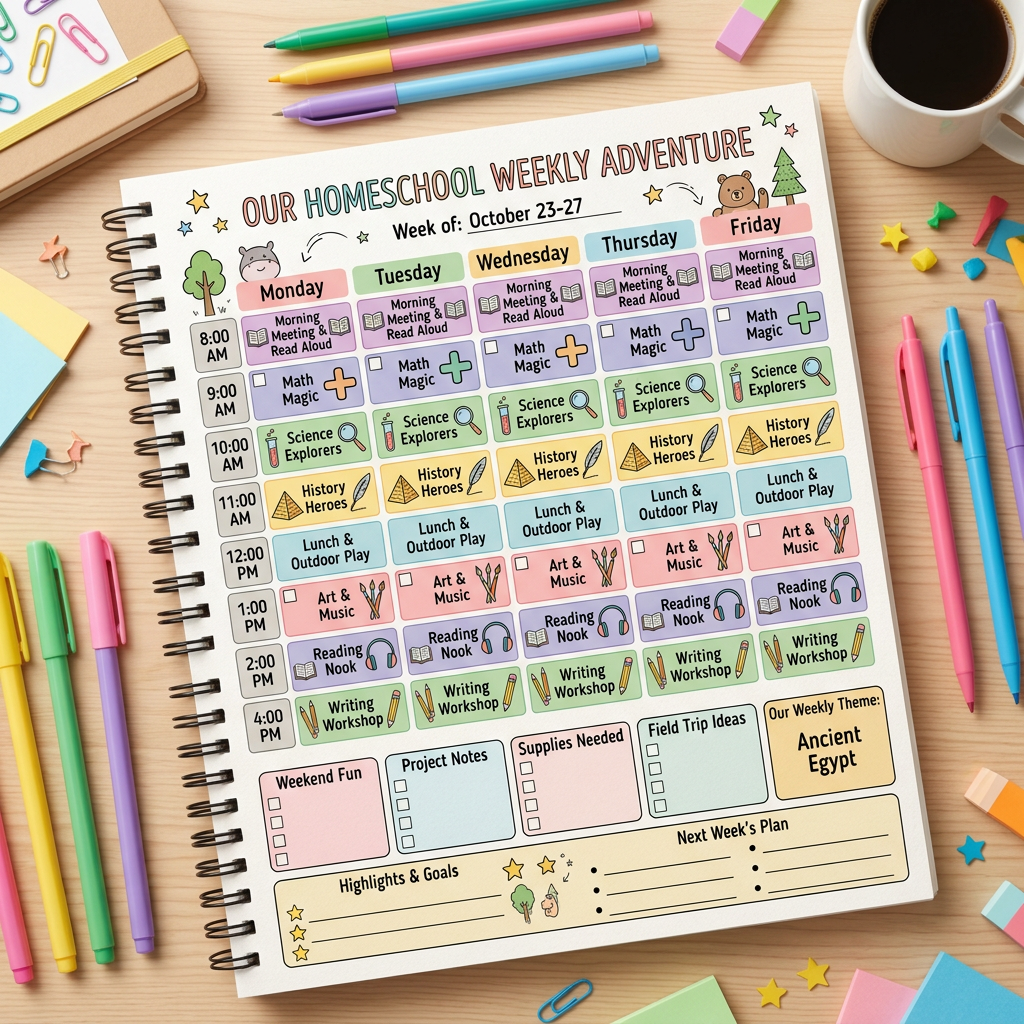
The best homeschool schedule is the one you can stick with on normal weeks—and still mostly stick with on hard weeks.
This weekly structure works whether you’re:
- in the Florida Home Education Program,
- homeschooling under an umbrella/private school,
- or blending home learning with FLVS.
It’s built for real life: working parents, appointments, motivation dips, and students who need consistency.
The rule: build your schedule around “non-negotiables”
Pick 3–4 anchors you protect first:
- reading
- writing
- math
- one content block (science or social studies)
Everything else rotates.
K–5 weekly schedule (simple + consistent)
Daily (Mon–Thu):
- Reading: 20–30 min (mix read-aloud + practice)
- Math: 20–30 min
- Writing/phonics: 15–20 min
- Content (science/social studies): 20 min
Friday:
- project day + review games + library time
Parent tip: Keep lessons short. End on a win.
Middle school schedule (structure + stamina)
Daily:
- Reading: 30 min (with short responses)
- Math: 30–40 min
- Writing: 20 min (paragraphs weekly)
- Content: 30 min (rotate science/social studies)
Weekly must-haves:
- 1 discussion (you + student)
- 1 longer writing piece with revision
- 1 hands-on science activity or investigation
High school schedule (credits + independence)
High school students need autonomy with accountability.
Daily:
- ELA: 45–60 min (reading + writing)
- Math: 45–60 min
- Science or social studies: 45–60 min (rotate by day)
- Elective/career skill: 30–45 min
Weekly must-haves:
- 1 planning session (15 minutes): due dates, pacing, check-ins
- 1 writing assignment with revision
- 1 “evidence of learning” folder update (samples)
If using FLVS: add a daily “learning coach” check-in: what’s due, what’s blocked, what’s next.
The 20-minute rescue plan (for chaotic weeks)
When life happens, keep the basics alive:
- 10 minutes reading
- 10 minutes math practice
That’s it. Two weeks of “rescue mode” is better than stopping completely.
Leave a Reply