
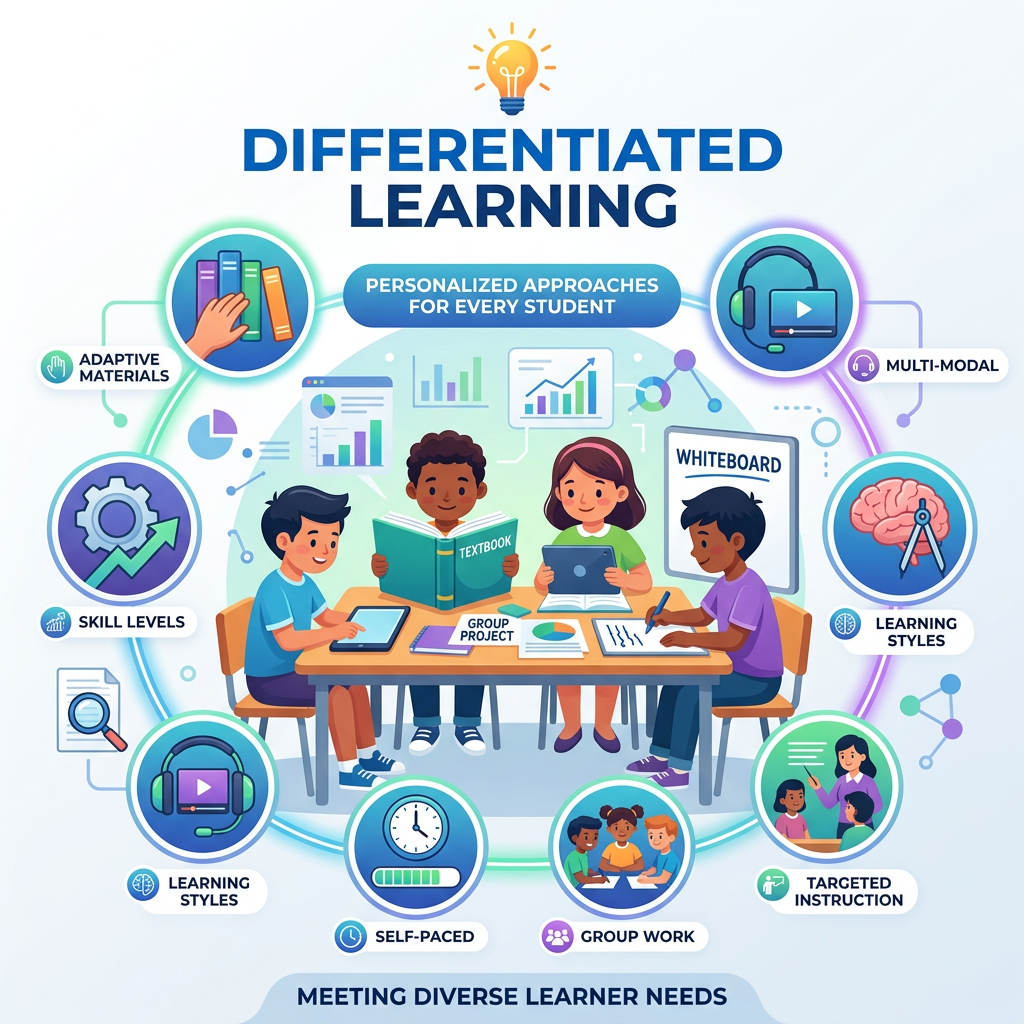
Differentiation in alternative schools isn’t a nice-to-have—it’s survival.
When students arrive with wide skill gaps, inconsistent attendance, or unfinished credits, “one lesson, one pace” just doesn’t hold. The challenge is time: teachers can’t create three versions of everything, every day.
This is where AI tools can help. Not by replacing your planning, but by helping you generate usable first drafts—so you can spend your energy on relationships, delivery, and the real-time adjustments that matter.
The goal: same learning target, multiple on-ramps
Good differentiation keeps the destination consistent while changing:
- the reading level
- the amount of scaffolding
- the output format (write/speak/build)
- the practice path
AI is strong at reformatting, simplifying, and generating parallel examples.
Step-by-step differentiation workflow (15–25 minutes)
Step 1: Define the “non-negotiables”
Write these down before you use any tool:
- Essential question
- Success criteria (what mastery looks like)
- One formative check (how you’ll know)
Step 2: Paste your base lesson (or standards + topic)
Then ask for three levels.
Prompt (copy/paste):
You are an expert alternative school teacher. Differentiate this lesson into 3 versions:
A) Emerging skills (more scaffolds, shorter text, guided practice)
B) On-level (standard version)
C) Extension (deeper thinking, transfer, or real-world application)
Keep the same essential question and success criteria. Include:
- a 5-minute warm-up
- a brief mini-lesson outline
- guided practice + independent practice
- a quick formative check (exit ticket)
Lesson/topic: [paste]
Step 3: Ask for “attendance-proof” options
Alternative settings need lessons that work even when half the class is new today.
Prompt:
Modify each version so it works for students who missed yesterday. Add a 3-minute recap and a self-contained “catch-up” box.
Step 4: Create choice-based outputs (so students can show mastery)
Prompt:
For each version, give 3 output options: one writing-based, one verbal/discussion-based, and one hands-on/creative option. All must demonstrate the same success criteria.
Step 5: Build a 10-minute reteach plan for common errors
Prompt:
Predict the 5 most common errors students will make. For each, give a 2-minute reteach move and one practice item.
Example: what to differentiate first (highest ROI)
Start with the materials that take the most time to rework:
- reading passages
- directions and task lists
- practice sets
- rubrics
- exit tickets
Common pitfalls (and quick fixes)
- AI makes it too long → Add: “Keep each version to one page.”
- It lowers rigor too much → Add: “Do not change the learning target.”
- It doesn’t fit your students → Add: “Assume trauma-informed, relationship-centered environment; avoid punitive tone.”
A teacher-friendly weekly routine
- Monday: Differentiate one core lesson + exit ticket
- Midweek: Use AI to generate reteach + practice sets
- Friday: Generate review game/questions aligned to the same success criteria
Leave a Reply